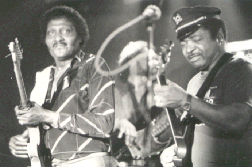
 (Sam Taylor with Albert
Collins)
(Sam Taylor with Albert
Collins)(Sam Taylor with Albert
Collins)
By Tina Alvarez
The problem with interviewing Sam Taylor is, where do you start?
For those of you who don't know, Blues Legend Sam Taylor is quite
the modest celebrity. Born in 1934 in Mobile, Alabama, he comes
from four generations of gospel singers, banjo pickers, minstrel
players and vaudeville people.
"You're not a Taylor if you can't rock a little bit,"
he said, laughing.You gotta sing or something." And, with
13 children, 15 grandchildren and three great grandchildren, there
must be a whole lotta shaking going on.
Sam, who lived in Mobile until he was 11, moved with his family
to Brooklyn, New York, where he began a boxing career, which lasted
13 years.
"I truthfully wanted to be the champion of the world,"
he admitted. "I wanted to be a prize fighter. I didn't want
to follow everyone else, you know?"
Sam had been singing gospel since he was three years old, but
actively started singing during the last three years of his boxing
career. In 1953 he joined the Air Force.
"I stayed there until 1957. It took me that long to realize
that I was no soldier," he recalled. "I started pursuing
a music career full-time and it's been that way ever since."
Sam has resided in Tucson for the last 11 years. Prior to that
he had been living in the Los Angeles area for 13 years. So what
made him decide to relocated to Tucson?
"Kidd Squidd -- the DJ from (Tucson, AZ. community radio
station KXCI-FM)," he said without hesitation. "He was
my neighbor in Venice, CA. He kept telling me, 'Sam, you need
to come to Tucson.'" Sam eventually ventured into Tucson
to play agig and was impressed with the hospitality he received.
The trip made him realize his true feelings.
"I really wanted to leave LA cause I got caught in the drug
scene. I had to get out of there and try to save my life -- and
here I am," he attested.
"Since April I've been here 11 years and since then I've
been drug free. Just moving here turned my whole life around.
This place has a special meaning for me."
In reciprocation, together with his band, Sam treats his audiences
with his own brand of special performances. Currently, the line-up
in the Sam Taylor Blues Band Featuring Heather Hardy consists
of violinist Heather Hardy, bassist Mike Nordberg, guitarist Brian
Dean and drummer Jerome Kinsey. As far as recent albums go, Sam
said they have a live CD they recorded while in
Europe last year. Another they recorded before they left for Europe,
at the Rhythm room, should be out shortly, he said.
Speaking of band members, I mentioned the name of my illustrious
boss, J.J. Terre (Phoenix publisher). "I don't know if you
remember him," I began . . . "God Almighty!," he
bellowed. "No, come on!"
"He used to play with you he told me."
"Why, he played with me in Venice," Sam recounted.
"Yeah, so tell me," I pried, "was he a good musician?
I mean, spill some beans about him"
"He was a fine drummer, you know. He was a lady's man, but
he was a good drummer," Sam declared. "He was quite,
quite, quite the go-getter. He also played some with my son Bobby.
He's quite a young man.
"I'm really proud of him," he continued, "because
I can remember when his stuff was not that good, but he's always
been a good musician. I saw him one time in all the years I've
been here. He stopped by and he hasn't been by to see me since."
Sam has an illustrious background in the music scene. In the 50's
he cut "Ain't That Some Shame" with Bobby Robbins who
owned Fire and Fury Records. Also on that label was Ike and the
Aces -- Ike Turner's band.
"Bobby's the guy that did "Danny May." He was the
first guy to record Gladys Knight and the Pips," he reminisced.
"He had Ruben and the Romantics, a lot of people. He had
the biggest record company. He once had the number one, two and
three songs on the R&B charts."
To his credit, Sam was in one of the first big integrated bands
in the country, Joey Dee and The Starliters ("Peppermint
Twist"), playing the Peppermint Lounge during the Twist Craze.
"I did a tour with the Beatles before they even came here,"
recollected Sam. "We were number one over here and they were
number one over there. They were always asking me about Bo Diddley
and stuff. When we got ready to leave after their tour, they came
to the airport with us."
The Beatles told Sam they would love to perform in the United
States.
"Joey (Dee) said to them, 'Dudes, you've got to come stay
at my house, I've got room," continued Sam. "Within
three months they were the hottest thing in the world. I haven't
seen any of them since that day."
Sam acknowledged that his mission in life is to put the blues
in its rightful place, to have it respected.
"People think cause you say the blues, the music is going
to be something that makes you feel bad. Nah. The blues takes
your blues away," he explained. "It lets you know thereís
someone else out there going through the things you are. It's
a music of feeling. I can't cure all your ills, but youíll
leave feeling better. I promise you that."
Bluesmen taught rock 'n roll musicians just about everything they
know. When American and English musicians took R&B to heart
in the '50's, no doubt itwas because it was a source ofinspiration
as timeless as truth and as true, as time.
Evident in Sam's style, air-clearing blues chords are true grit
in the hands of a true bluesman. A blues artist leaves nothing
to be desired, everything to be had. A blues master is a guy who
has been playing since he was old enough to cry. Sam creates sounds,
heís not concerned about hitting notes. His sounds are
as beautiful as they are emotional. He wastes no moments.
It took the English Invasion of 1964 to get American children
of rock back to their blues heritage. Thanks to John Lennon, Mick
Jagger and others, by 1968 there was a large blues revival. Citing
more currents manes like Bonnie Raitt, Stevie Ray Vaughn and Eric
Clapton, Sam credited white people with keeping the blues going.
Sam pointed out that blues is making headway onto mainstream America,
with major corporations like Miller, Budweiser, Goodrich and Jaguar
utilizing the music in their advertisements. Older rock stars
are releasing albums celebrating the blues roots of their styles.
New groups like Bighead Todd and Toad the Wet Sprocket are aversion
of pumped-up blues (As are Blues Traveler, The Black Crowes and
even bands like Pearl Jam).
"It's been kind of hard getting the younger black kids to
play the blues," he lamented. Perhaps a reason is that the
blues go back to the Mississippi Delta of the post-civil war era
and the music was attached to the social stigmatism of slavery.
"I'm really glad I stuck to my guns," Sam confessed.
"I had people try to change me, like record companies. I've
got to let it go the way the Lord gives it to me. I haven't changed.
It's too late now."
Sam noted that he wrote a lot of songs for many people who made
good money off of his work. He sold seven songs to the Rolling
Stones, one of which they recorded -- "Midnight Rambler"
-- a number that Sam says wasn't even the best in the bunch. In
all, his songs have been covered by a diversity of people from
Freddy King to Tiny Tim.
"I'm not bitter, because first of all, I haven't written
my best stuff yet. I hope I never do," he conceded. "After
I had that second open heart surgery I thought, I loved life before,
but I really got me a romance with it now."
Sam received his first open heart surgery 15 years ago. When he
was due for another one, he had to search for a doctor to operate
on him. After the surgery, Sam was in the hospital for four months.
For the majority of his stay he was on a respirator. At times,
he felt like he wasn't going to make
it.
"I saw the light and somebody said, 'No, it ain't your time.'
I felt the coolest calmness. I've been far enough that I know
this -- there's something after this life," he verified,
his eyes beaming. "Yeah, I've been there. I don't know how
I got back."
In the hospital Sam was kept restrained because he kept trying
to pull out the respirator and tubings. When he was untied, three
finger on one hand, and two on the other were numb. He also had
a tracheotomy and thought, between the two physical limitations,
that he would never be able to play or sing again.
"They finally got me sitting up and I had my guitar in the
he room," he described. Each day a special friend would come
by and put his guitar on his lap.
"I couldn't play. I'd sit there and cry because I couldn't
play and I didn't even want to live," he remembered. "I
didn't think I was going to make it and it was real, real scary."
But, as he was informed, he was intended to stick around for a
time.
"Well, I've been around long enough," he stated quite
frankly. "I have over 130 record songs. Spent most of my
life playing for the people I was teaching."
Sam alluded to one singer he worked with, Maxine Brown, who wouldn't
sing a song unless he did it first. If Sam could sing it, the
she'd sing it.
Among the performers he's played with are Otis Redding, Sam and
Dave, T-Bone Walker, Solomon Burke, Little Johnny Taylor and Big
Joe Turner, who called him the Crown Prince of the Blues.
On a non-musical side, when Sam has some spare time, his favorite
hobby is playing golf. At seven years of age he worked as a caddie
and has been hooked ever since. In fact, during 1991 he won the
Annual Tucson Amateur Championship.
However, Sam considers the biggest accomplishment in his life
as becoming drug free. Either way you look at it, his victory
overcoming substance abuse is just as admirable as his devotion
to the blues.
"My advice would be to have a love for the music, let that
be first," he emphasized. "I love what I'm doing. It's
a gift and I'm thankful for that gift. Just wrap yourself into
the gift, be thankful and it will grow by itself. Just keep learning,
don't ever stop. I can listen to songs I recorded 20 years ago
and the way I would do it now is a world of difference. Take your
drive or your desire and thereís no telling how far you
can go."
"If you quit, that's as far as you go," he continued.
"I enjoy it when it comes out. Then you get it and it comes
back to me again. I get more back. I hope I never lose that. Anytime
I play, I play like I'm not gonna play no more because I don't
know when my last one's gonna be. I've enjoyed myself, honey.
I got my cookie."
"I've made some people feel good and it's great to have a
gift that you can feel good about and can make someone else feel
good," he concluded. "We're all Gold's children, but
I'm one of God's miracles. I'm a rich man. I'm blessed."
See Tina Alvarez' second article about Sam Taylor
1998 EMOL. All rights reserved.