An old battered adobe building, with a
stone foundation, sitting at the mouth of the Cañada del Oro, has some
historical significance.
The undated structure may have been a mission in the 1700’s called the “Mission of Santa Catalina.”
As the site of a massacre only a dozen years earlier, and an Indian
treaty two dozen years before, Tucson pioneer Mariano G.
Samaniego found the canyon peaceful enough in the 1880s to build a
home and stagecoach line through the mountains. It was a way station for
miners crossing through the mountains during the 1800s, the main road
north through the mountains, and the first guest ranch in the area –
“Linda Vista Guest Ranch” - Rancho Linda Vista during the early 1900s.
Also known as Rancho Solano, it is a home with a mission and needs to be
preserved.
Flint Carter, a local miner and director of the Santa Catalina Historic Preservation Project (SCHPP), a project sponsored through SAI, Inc., a non-profit organization, is working to preserve and restore that history.
The possible "Mission of Santa Catalina," located at the mouth of the Cañada del Oro (Canyon del Oro) north of Tucson, Arizona.
The Santa Catalina Mountains and Tucson
valley is one of the longest, continuously inhabited regions in the
United States. Early human occupation in the area dates back about
10,000 years. The region has been inhabited by the Hohokam for thousands
of years and the by Apaches. The Spanish Jesuits mined the Catalina
Mountains for gold in the 1700s. Americans began mining the hills a
hundred years later.
The first documented ownership of the
property was Mariano Samaniego, Tucson pioneer. Samaniego arrived in
Tucson in the mid-1860s and became a freighter, cattle rancher, merchant
and a successful Hispanic public official.
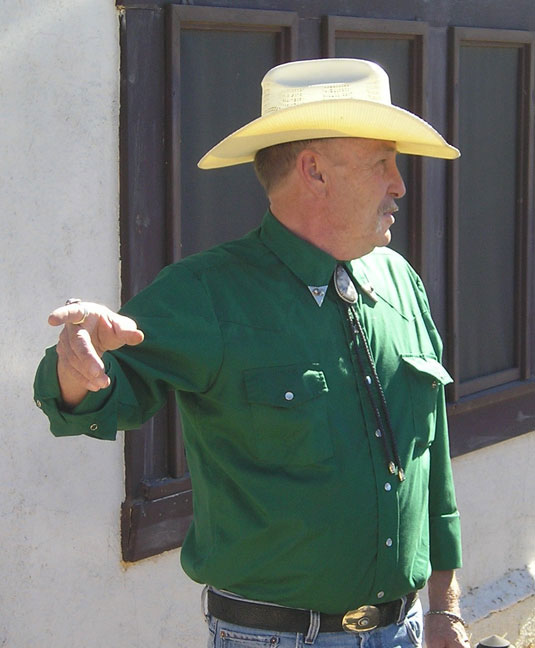
Flint
Carter is spearheading an effort to preserve and restore that adobe
building. He hopes someone will step forward to help purchase the
property and preserve the land and its history. Carter appeared in the
movie "Buffalo Bill: Beyond the Legend."
Carter, who has had mining claims
throughout the Santa Catalina Mountains for several decades, has a large
collection of rare ores mined from the area and antique mining
artifacts. He is documenting accounts about the early mining in the
Catalina Mountains, including the legendary Iron Door Mine and the Lost City of Ciru (Cibola) and Pueblo Viejo.
The Flint Carter Collection of mined
ores, fashioned jewelry and artifacts collected over 40 years would be
displayed in a museum setting at the Mission of Santa Catalina.
Visit the Oracle Inn in Oracle, Arizona to see the gold and silver collection from our Santa Catarina Mountains.
Donations to the SCHPP are tax-deductible to Southwest Alternatives Institute, Inc., a 501 3(c) non-profit Tucson, Arizona corporation, founded in 1977. Call 520-623-3733 for information on SAI.
Mt. Lemmon jewelry grade silver ore in quartz
Flint
Carter, a Tucson, Arizona miner, has samples of "Cody Stone" mined in
the Santa Catalina Mountains of Southern Arizona. This stone is
jewelry grade silver and quartz ore, and weighs 8 pounds or more. It
also contains scheelite and fluoresces. Valued at $5 a carat. This
particular piece is the second largest specimen recovered. Extremely
rare.
There is a 40 page provenance of the object, including an
assay by the University of Arizona and opinions from the
Gem Institute of America and other sources. More samples of Cody Stone. Call Flint Carter for more information, call 520-623-3733.
Plat map survey of the property. The adobe structure (left side) is the claimed Santa Catalina Mission.
Help create a museum to preserve Western history
This
lost Spanish mission is being restored by Flint to preserve its great
Western heritage and to house his collection of stones, jewelry, art and
artifacts recovered from around the Santa Catalina Mountains.
While Flint is doing the work on his own time and money, tax deductible donations through SAI, Inc.
are accepted to help toward its restoration and preservation. Call
Flint Carter in Tucson, Arizona at 520-289-4566 for more information.
Read more about legends of the Southwest US and Tucson:
 The Santa Catalina Historic Preservation Project
 Flint
Carter is spearheading an effort to preserve and restore that adobe
building. He hopes someone will step forward to help purchase the
property and preserve the land and its history. Carter appeared in the
movie "Buffalo Bill: Beyond the Legend."
Flint
Carter is spearheading an effort to preserve and restore that adobe
building. He hopes someone will step forward to help purchase the
property and preserve the land and its history. Carter appeared in the
movie "Buffalo Bill: Beyond the Legend."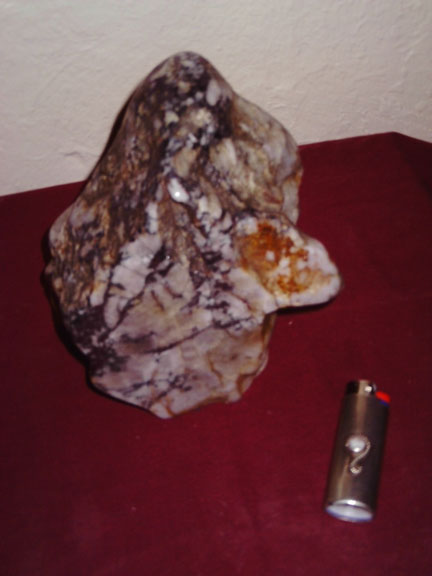 Flint
Carter, a Tucson, Arizona miner, has samples of "Cody Stone" mined in
the Santa Catalina Mountains of Southern Arizona. This stone is
jewelry grade silver and quartz ore, and weighs 8 pounds or more. It
also contains scheelite and fluoresces. Valued at $5 a carat. This
particular piece is the second largest specimen recovered. Extremely
rare.
Flint
Carter, a Tucson, Arizona miner, has samples of "Cody Stone" mined in
the Santa Catalina Mountains of Southern Arizona. This stone is
jewelry grade silver and quartz ore, and weighs 8 pounds or more. It
also contains scheelite and fluoresces. Valued at $5 a carat. This
particular piece is the second largest specimen recovered. Extremely
rare. 

